.png)
Viral Trends Create Exogenous Variation: Evidence from the “Kia Boys”
Published:
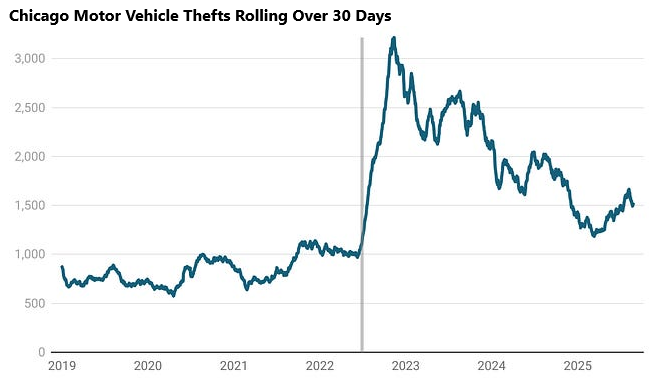
John Arnold recently highlighted the figure below from one of Jeff Asher’s Substack posts. This got me thinking about how viral trends from TikTok or other platforms might create exogenous variation that can be exploited for causal inference.
All U.S. market Kias manufactured from 2011 to 2021 and all Hyundais from 2016 to 2021 lacked an immobilizer-an electronic security device which makes sure the correct key is inserted before starting the car (Frank 2022). This, combined with their steel key made Kias and Hyundais more susceptible to theft. Targeted auto theft of Kias and Hyundais began in early 2021 in Milwaukee, where teenagers were exploiting the flawed design. A video was posted on TikTok by Markell Hughes on July 12, 2022 showing how a USB connector can be used to start one of these cars (List 2022). This video went viral gaining over 500,000 views and created the so-called “Kia Challenge” (Jannene 2022 and Morrison 2023). Hughes and others in Milwaukee were dubbed the “Kia Boys” and Tom Gerszewski made a viral youtube video about them in 2022.
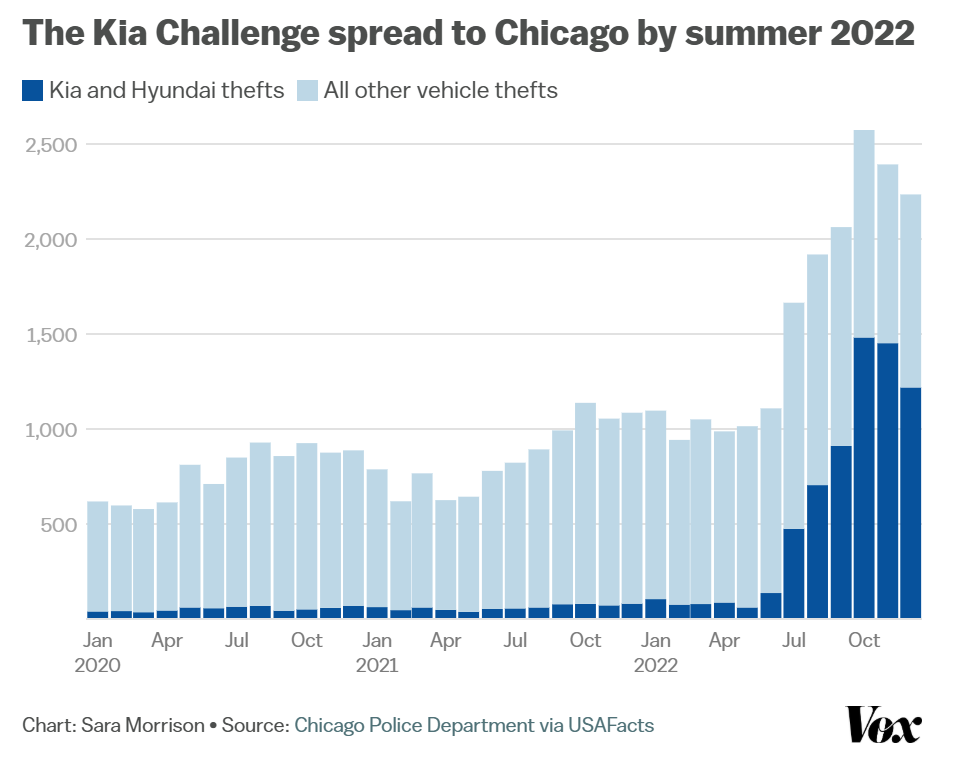
This challenge was far more dangerous than your average social media challenge. Thefts of Kias and Hyundais more than tripled, and criminals weren’t simply substituting away from other cars to these Korean brands. Total motor vehicle thefts jumped in July and remained higher than before for over a year. This is broken down by Kia and Hyundai thefts below (Morrison 2023). In all, the challenge resulted in a $200 million class-action settlement paid by Hyundai Motor Group, the owner of Kia and Hyundai (Medina 2023).
While the “Kia Challenge” is unique in its criminal consequences, social-media trends are a dime a dozen. My personal favorites are the recurring water-bottle fads (I use these to teach demand shifts due to changes in preferences to my students). Such “challenges” may change preferences and drive behaviors. The figure above shows the 30-day rolling average of motor vehicle theft in Chicago. While Chicago is natorious for its crime, there’s no reason to think a jump didn’t occur in most metropolitan areas. We see this discontinuity in July more clearly in the figure below. If this pattern holds across many areas, it would provide enough exogenous variation to use a fuzzy regression discontinuity design.
This was a somewhat silly research idea I had, but there isn’t an entirely clear outcome. The cleanest outcome is probably other types of crime. This could give information on which types of crime are substitutes and compliments to motor vehicle theft which, while niche, remains unanswered. More importantly, I think the “Kia Challenge” unintenionally created by Hughes and the “Kia Boys” highlights that these common social media trends create exogenous variation that researchers can exploit to obtain causal inference. This is much in the same vein as Melissa Kearney and Phillp Levine’s paper, which uses variation in viewership of 16 and Pregnant. The key is finding the right trend which can be used as an instrument to answer an important question.
On another note, why did Hughes make the video in the first place? Presumably, he could have continued using this trick had he not alerted the world to what he was doing. However, the Milwaukee Police Department was already aware of these antics and had begun distributing free steering-wheel locks to Kia and Hyundai owners in February 2021 (Robles 2021).